Showing posts with label books. Show all posts
Showing posts with label books. Show all posts
Monday, February 26, 2018
Consumer Alert.
Steven Seagal has a novel out, The Way of the Shadow Wolves. Don't read it. Why? Just read this review. Having said that I'm sure reading this book might be of benefit to some would be writers. After all if Stevie can get such a badly written piece of nonsense published their much better stuff might stand a chance.


Thursday, January 30, 2014
Not This Time, Richard.
For as long as I can remember the Co Op grocery on 8th St. in Saskatoon has had a "give one, take one" book shelf. The idea is that you leave books you're done with and take others you think you want to read. I went in there this afternoon and decided to take a look. I got a little bit excited when I spotted some of my favourite elusive trash: Death Merchant books. But my excitement was short lived, as they were all books I currently have in my possession. Still, I guess that means I'll have to keep my eyes open, in case any turn up.
Which ones do I want to get my hands on, you ask? Just three really, namely The Castro File, The Vengeance of the Golden Hawk, and The Fourth Reich. Those are the ones I haven't actually read, while some of the others I don't currently have I've either read, or don't want to read. For example Blood Bath is one I just can't make myself read, as I suspect the racism quotient is especially high in that one.
Which ones do I want to get my hands on, you ask? Just three really, namely The Castro File, The Vengeance of the Golden Hawk, and The Fourth Reich. Those are the ones I haven't actually read, while some of the others I don't currently have I've either read, or don't want to read. For example Blood Bath is one I just can't make myself read, as I suspect the racism quotient is especially high in that one.
Sunday, December 29, 2013
The Pile.
At the moment I have rather a large pile of books on my bedside table, all of which I'm in the process of reading. Some I've just started, others, I've been going at for a while now. They are:
-The End: The Defiance and Destruction of Hitler's Germany, 1944-1945, by Ian Kershaw.
-The Strat In The Attic: Thrilling Stories of Guitar Archeology, by Deke Dekerson.
-Who I Am, by Pete Townshend.
-Rommel's Lieutenants: The Men Who Served the Desert Fox, France, 1940, by Samuel W. Mitcham, Jr.
-This Wheel's on Fire: Levon Helm and the Story of the Band, by Levon Helm with Stephen Davis.
-On Some Faraway Beach: The Life and Times of Brian Eno, by David Sheppard
-Rolling Thunder Against the Rising Sun: The Combat History of U.S. Army Tank Battalions in the Pacific in World War II, by Gene Eric Salecker.
You can cay they're all history books. They're all books that are my personal property, not library books. And there's at least another history book I should really go buy, assuming a copy is still in the cheapy section at McNally-Robinson in a few days. Not that I'll tell you what that book is, you might go buy them all out if I do.
-The End: The Defiance and Destruction of Hitler's Germany, 1944-1945, by Ian Kershaw.
-The Strat In The Attic: Thrilling Stories of Guitar Archeology, by Deke Dekerson.
-Who I Am, by Pete Townshend.
-Rommel's Lieutenants: The Men Who Served the Desert Fox, France, 1940, by Samuel W. Mitcham, Jr.
-This Wheel's on Fire: Levon Helm and the Story of the Band, by Levon Helm with Stephen Davis.
-On Some Faraway Beach: The Life and Times of Brian Eno, by David Sheppard
-Rolling Thunder Against the Rising Sun: The Combat History of U.S. Army Tank Battalions in the Pacific in World War II, by Gene Eric Salecker.
You can cay they're all history books. They're all books that are my personal property, not library books. And there's at least another history book I should really go buy, assuming a copy is still in the cheapy section at McNally-Robinson in a few days. Not that I'll tell you what that book is, you might go buy them all out if I do.
Friday, August 31, 2007
I Wouldn't Have Used That Title.
Looking through the book isle at London Drugs today I noticed a book in the Science Fiction section with a slightly surprising title. It was Vaders by R. Patrick Gates. The publisher considers it horror, but even given that I was surprised to see someone using that name for a book given everyone's favourite Lord of the Sith, Darth Vader. You'd think Gates and the book's publisher, Pinnacle, would be worried about running afoul of George Lucas's lawyers, even though the book itself has nothing in it that could be considered a Star Wars ripoff. People have gotten into legal trouble over such things, such as Saskatchewan restaurant chain Tomas the Cook, which was originally Tomas Cook until the travel firm Thomas Cook took umbrage, even though the two are in different businesses.
Monday, January 08, 2007
This Week's Reading.
Yep, you got it. I'm so hard up for something to write to prove I'm not dead that I'm going to post what I'll be reading this week. On the agenda are:
MacArthur's War: Korea and the Undoing of an American Hero by Stanley Weintraub
Phil Gordon's Little Green Book: Lessons and Teachings in No Limit Texas Hold'em by Phil Gordon. Boy, I bet you were surprised to find out that book was written by Phil Gordon.
I'll probably be reading something else this week as well.
MacArthur's War: Korea and the Undoing of an American Hero by Stanley Weintraub
Phil Gordon's Little Green Book: Lessons and Teachings in No Limit Texas Hold'em by Phil Gordon. Boy, I bet you were surprised to find out that book was written by Phil Gordon.
I'll probably be reading something else this week as well.
Wednesday, May 03, 2006
Moneymaker
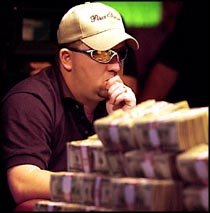
As part of my ongoing effort to learn a bit more about poker this week I read Moneymaker by Chris Moneymaker and Daniel Paisner. Its a first hand account of how Moneymaker went from being an unknown amateur no one would have considered even a minor threat to winning the 2003 World Series of Poker. Its a pleasant and quick read. What's interesting is that Moneymaker had been gambling in one form or another since he was a little kid, and that his college and after college gambling had left him in debt. Whether one could call Moneymaker an addict is debateable, but his gambling debts were such that only the promise of money from a friend lead him to win a free seat to the World Series via an online poker tournament instead of in effect throwing the tournament so he would win the second prize of $8000. A free seat at the pinnacle of US poker events was far less valuable than actual money that could go a long way to paying off debts a young accountant with a wife and baby couldn't afford. Equally ironic was that winning the 2.5 millon dollar grand prize ended Moneymaker's financial problems, yet introduced a whole new set of tensions that proved equally as hard on his personal life as being in debt had been. Definitely an interesting case to consider when you see the jubilation of the winner of such an event.
Monday, November 28, 2005
Starting with his first recording sessions as a sideman in 1945 the recording career of Miles Davis would cover a span of nearly 50 years. During that time he would become the most influential trumpet player in post World War 2 jazz, and only overshadowed as most important jazz trumpet player period by Louis Armstrong. Not surprisingly a large number of books have been written about Davis, covering the entirety of his career. The most recent is The Last Miles: The Music of Miles Davis, 1980-1991 by George Cole. This is the only book to date to concentrate on the music Miles made in the last years of his life. His comeback at the beginning of the 1980s shocked many, as poor health and a renewed problem with drug addiction had forced him into retirement in 1975. As was often the case with Miles the music was controversial, as so much of it was more overtly commercial, for lack of a better term, than even his electric music of the '70s.
Cole provides an in depth look at this period from the perspective of someone who enjoys this period of Miles' work. He obviously couldn't discuss this music with the most important person in the story, Miles himself, but he interviewed the majority of those musicians involved with this period, as well as members of the road crew, employees of Columbia Records and Warner Brothers Records, and friends and family. Although this is primarily a book about the music we also get a look at elements of Miles' personal life of the period given that its impossible to separate a musician's work from the rest of his life, and the ups and downs of Davis' health played a considerable role in that last decade of work. Cole gives us a comprehensive look at the studio recordings, live performances, and Miles' guest appearances on the recordings of others. There are a few places where I found Cole's description of certain technical elements of the recording process slightly off, but these aren't likely to be noticed by the non musician. Overall this is an enjoyable book, recommended for anyone interested in the music of Miles Davis.
Cole provides an in depth look at this period from the perspective of someone who enjoys this period of Miles' work. He obviously couldn't discuss this music with the most important person in the story, Miles himself, but he interviewed the majority of those musicians involved with this period, as well as members of the road crew, employees of Columbia Records and Warner Brothers Records, and friends and family. Although this is primarily a book about the music we also get a look at elements of Miles' personal life of the period given that its impossible to separate a musician's work from the rest of his life, and the ups and downs of Davis' health played a considerable role in that last decade of work. Cole gives us a comprehensive look at the studio recordings, live performances, and Miles' guest appearances on the recordings of others. There are a few places where I found Cole's description of certain technical elements of the recording process slightly off, but these aren't likely to be noticed by the non musician. Overall this is an enjoyable book, recommended for anyone interested in the music of Miles Davis.
Tuesday, May 24, 2005
I finally finished reading Bradley K. Martin's Under the Loving Care of the Heavenly FAther: North Korea and the Kim Dynasty, his profile of North Korean dictators the late Kim Il Sung and his son Kim Jong Il. An excellent look at North Korea, albeit a very long one at 868 pages. I wouldn't recommend reading it as fast as I've been trying to. Its interesting to read actual stories from those who have defected from North Korea, Martin having talked to both commoners and those of high standing who have defected. I'm sure most readers will find it hard to imagine living in a country like North Korea has been for most of its history, where the majority of people were inculcated in a rigid ideology with no real knowledge of how the rest of the world really worked. Martin avoids the temptation to portray the Kims as one dimensional boogiemen, and its not hard to gather the impression that they have often been as much victims of the insularity of the North Korean worldview as anyone else, with tragic results. Yet the fact that such a society could actually produce those who could see through all this and act counter to their upbringing, whether to engage in dissent or simply to escape, may be a glimmer of hope that North Korea can make its way out of its current moribund state.
Saturday, September 11, 2004
A while back I commented on here at my amusement at some of the prices online book sellers wanted for titles from the Death Merchant action/adventure book series. I was just doing a little bit of looking for stuff on horror novelist Edward Lee's book Coven, and I found references to copies of it selling for as much as 150 bucks! Wow, all that for a horror paperback. A limited edition hardback version came out sometime within the last year or so at a mere 45 bucks American, but it was only 300 copies so I imagine the price of these may go up as well.
Coven is amazingly over the top. It tells the tale of a university town that is menaced by an evil alien entity from elsewhere and his army of cloned minions, who look like sexy young women and run around kidnapping people to crossbreed with other aliens the creature has kidnapped. Lots of violence, sex, and sex mixed with violence. If you've ever wanted to read a scene where a woman projectile vomits due to an orgasm induced by being screwed by an alien this is the book for you. The sheer gonzoness of it made me wonder exactly which parts were to be taken seriously and which were to be considered extreme black humour. Lee's later books that I read didn't seem to have the dark humour element that Coven does, but certainly had the mix of sex and bizarre that Coven does.
Books like Coven, some of C. Dean Anderson's stuff, and others I thumbed thru in the late '80s and early '90s made me smirk a lot when the controversy exploded over Bret Easton Ellis's American Psycho. The only reason this happened at all was because American Psycho was written by a supposed mainstream writer, and would have been published by Simon and Schuster if not for the complaints. You could find all sorts of books with similar or worse violence haunting the horror sections of the era, but you didn't see reams of ink and hours of tv time spent analysing them. And personally I found Ellis's writing so bland that the whole thing seemed lifeless and didn't get the "this is disgusting stuff" section of my brain going like some of the other stuff I ran across.
Coven is amazingly over the top. It tells the tale of a university town that is menaced by an evil alien entity from elsewhere and his army of cloned minions, who look like sexy young women and run around kidnapping people to crossbreed with other aliens the creature has kidnapped. Lots of violence, sex, and sex mixed with violence. If you've ever wanted to read a scene where a woman projectile vomits due to an orgasm induced by being screwed by an alien this is the book for you. The sheer gonzoness of it made me wonder exactly which parts were to be taken seriously and which were to be considered extreme black humour. Lee's later books that I read didn't seem to have the dark humour element that Coven does, but certainly had the mix of sex and bizarre that Coven does.
Books like Coven, some of C. Dean Anderson's stuff, and others I thumbed thru in the late '80s and early '90s made me smirk a lot when the controversy exploded over Bret Easton Ellis's American Psycho. The only reason this happened at all was because American Psycho was written by a supposed mainstream writer, and would have been published by Simon and Schuster if not for the complaints. You could find all sorts of books with similar or worse violence haunting the horror sections of the era, but you didn't see reams of ink and hours of tv time spent analysing them. And personally I found Ellis's writing so bland that the whole thing seemed lifeless and didn't get the "this is disgusting stuff" section of my brain going like some of the other stuff I ran across.
Subscribe to:
Posts (Atom)
